League of Legends began with a very simple economic proposition: remove the price of entry.
The game launched as free-to-play, allowing Riot Games to build an enormous player base before asking those players to spend money on cosmetics and other digital goods.
But over time, Riot built something much larger around that game.
League of Legends became a competitive ladder, a professional sport, a global streaming product, a live-event business, a music platform, an animation property and one of the clearest examples of how a video game can become an entertainment ecosystem.
Esports sits at the center of that transformation.
Not because competitive League of Legends necessarily generates the majority of Riot's revenue directly, but because competition gives the game something that most entertainment products struggle to manufacture: a permanent narrative.
Every season creates winners, losers, rivalries, transfers, personalities, controversy and anticipation.
The game produces its own stories.
And Riot owns the world in which those stories take place.
This is where esports becomes structurally different from traditional sport.
No company owns football.
FIFA, UEFA, domestic leagues, clubs, broadcasters, sponsors and players all control different pieces of the ecosystem.
League of Legends works differently.
Riot owns the game itself.
That gives the publisher an unusual degree of control over the competitive system built on top of it.
It can change the rules of the game.
It can define the professional circuit.
It can determine which organizations participate.
It can create the broadcast product.
It can design digital objects connected to tournaments and teams.
And it can modify the underlying economic model when the system stops working.
That last point has become particularly important.
As esports professionalized, many leagues adopted structures inspired by established sports.
Long-term league participation was designed to give teams stability.
Stable participation could help organizations sign players, sell sponsorships and build recognizable brands without the constant risk of disappearing from the top competition after one bad season.
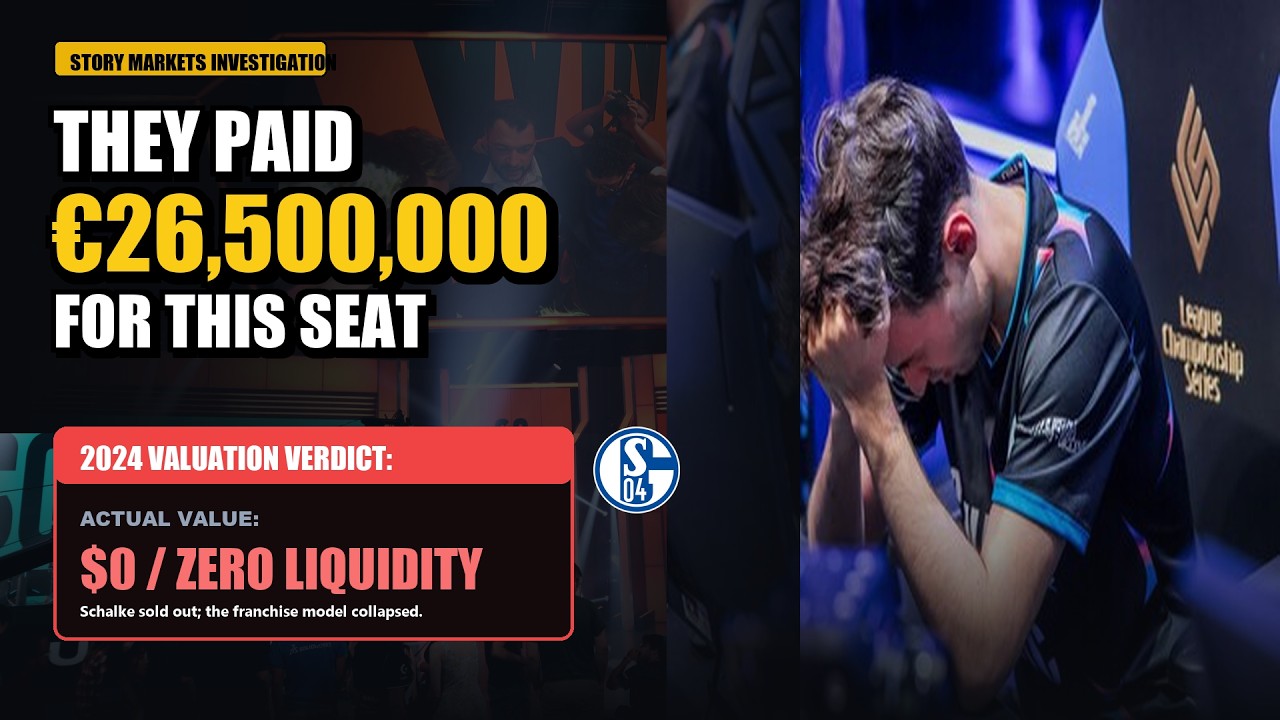
In several major League of Legends ecosystems, teams committed substantial participation fees and received a share of league-generated revenue.[1]
The logic was understandable.
Create stable teams.
Build recognizable leagues.
Sell sponsorship.
Develop media rights.
Grow the value of the competition.
But the economics proved more difficult.
Team costs increased.
Capital became less abundant.
Sponsorship markets became less predictable.
And media rights never developed into the same economic engine that supports many traditional sports.[1]
Riot eventually acknowledged the structural problem.
The interesting part is what came next.
Riot's newer economic model moves away from making sponsorship and media revenue the central mechanism of team economics.[1]
Instead, it places much more emphasis on digital content sold inside League of Legends.[1][3]
Teams receive more predictable support while participating in a global revenue pool connected to esports digital products.[1]
That changes the logic of the business.
A traditional sports league attempts to monetize attention around the competition.
League of Legends can monetize that attention inside the product itself.
A fan does not need to purchase a television subscription or attend a stadium.
They can express fandom through the game's own economy.
Skins.
Emotes.
Team-linked items.
Tournament content.
Cosmetics connected to competitive moments.
The spectator can become a customer without ever leaving the game.
That is one of the most important structural advantages esports has over traditional sport.
Riot's Global Revenue Pool makes another interesting change.
Revenue is not distributed only according to participation or competitive performance.
Part of the system explicitly rewards fandom.[1]
That is significant because it recognizes something that esports organizations have understood for years:
being good at the game and being valuable as an entertainment brand are not exactly the same thing.
A team with recognizable players, strong creators, active social channels and an emotionally invested community can create economic value even when it does not win the championship.
This pushes esports organizations toward a hybrid identity.
They are competitive teams.
But they are also media companies.
Talent managers.
Merchandise businesses.
Creator networks.
Community brands.
The competitive result matters, but so does the ability to transform competition into attention and attention into fandom.
Esports also developed with a distribution system fundamentally different from most traditional sports.
League of Legends grew in an environment where Twitch, YouTube and other streaming platforms allowed global competition to be distributed directly to viewers.
That lowered one of the traditional barriers to building a global sport.
You did not need a national television network to discover the competition.
You needed an internet connection.
But streaming did something else as well.
It created a new category of intermediary.
Casters.
Analysts.
Streamers.
Co-streamers.
Former professional players.
Creators.
They do not simply distribute the competition.
They interpret it.
The result is a media ecosystem where the official broadcast is only one possible way of experiencing the event.[4]
For younger audiences in particular, the personality explaining the match can become almost as important as the match itself.
The World Championship is the culmination of this system.
It is obviously a competition.
But it also functions as an annual global entertainment tentpole.[4]
Worlds concentrates attention.
It creates storylines.
It produces music.
It creates digital goods.
It generates sponsorship inventory.
It builds stars.
It produces moments that circulate through social media long after the games finish.
The event becomes a coordination mechanism for the entire League of Legends ecosystem.
The 2026 Tier 1 season operates across major regional leagues and multiple international events before culminating at Worlds.[2]
The structure keeps competitive narratives running throughout the year while reserving a small number of moments where global attention converges.[2]
This is not very different from what major sports have learned to do with finals, championships and international tournaments.
The difference is that Riot can connect those moments directly to the game's digital economy.
League of Legends becomes even more interesting when competition is viewed alongside everything Riot has built outside the game.
Arcane demonstrated that characters originating inside a competitive video game could support premium global animation.[5]
K/DA demonstrated how League characters could operate as virtual music performers.[6]
Riot has repeatedly used music, cinematics and character storytelling to make the universe legible even to people who may never play ranked League of Legends.
That creates an important feedback loop.
The game creates characters and worlds.
Esports creates ongoing spectacle and personalities.
Music creates cultural moments.
Animation expands the audience.
Creators distribute all of it.
The result is not simply a successful game with several marketing extensions.
It is an IP system in which different forms of entertainment continually reinforce the same underlying universe.
There is, however, a structural weakness inside the same model.
The advantage of esports is also its dependency.
Traditional sports can survive individual broadcasters, leagues or game publishers because nobody owns the underlying rules of football or basketball.
An esport ultimately depends on the company that owns the game.
If the publisher changes strategy, reduces investment, changes the competitive structure or eventually shuts the game down, the ecosystem built around it has limited autonomy.
Teams do not own the field.
Players do not own the sport.
Tournament organizers operate with permission from the owner of the underlying intellectual property.
This makes esports unusually powerful as a vertically integrated entertainment system — and unusually dependent on the strategic priorities of the publisher.
For years, esports was often discussed through a simple comparison:
Could competitive gaming become the next football, basketball or Formula 1?
League of Legends suggests that this may be the wrong question.
The most interesting version of esports may not be the one that reproduces the economics of traditional sports most accurately.
It may be the one that takes advantage of the fact that it is built inside software.
Competition can drive attention.
Streaming can distribute it globally.
Creators can interpret it.
Teams can organize fandom.
Digital goods can monetize it.
And the publisher can connect all of those layers inside the same economic system.
League of Legends is therefore not simply a game that became a sport.
It is a case study in what happens when a game becomes infrastructure for an entire entertainment economy.
- Riot Games — Adjusting our LoL Esports Strategy (2024)
- Riot Games / LoL Esports — LoL Esports Global Season Structure & Tier 1 League Operations
- Riot Games — VALORANT Esports in 2024: Digital Goods & Partner Revenue Sharing
- Esports Charts — League of Legends World Championship Viewership & Co-Streaming Telemetry
- Television Academy — Arcane: League of Legends Emmy Awards & Production Archive
- Riot Games Music — K/DA POP/STARS Official Debut & Worlds 2018 Case Study